


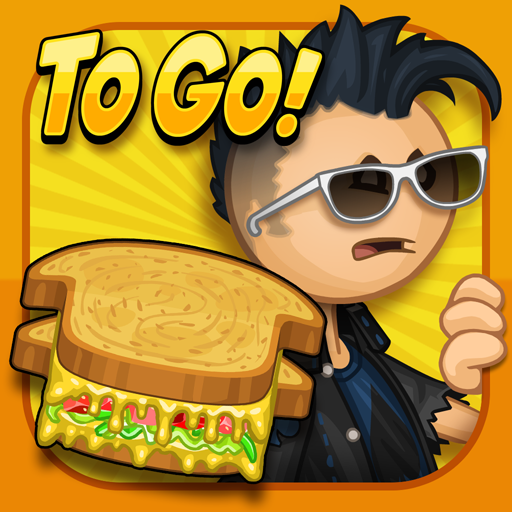
Running a grilled cheese restaurant sounds simple until several customers arrive at once, two sandwiches are cooking on the grill, fries are almost ready, and another order is waiting to be taken. That pressure is at the center of Papa’s Cheeseria, a time-management cooking game from Flipline Studios that turns sandwich making into a test of timing, accuracy, organization, and multitasking.
Released in 2015 as part of the Papa Louie restaurant series, Papa’s Cheeseria takes place in Toastwood and follows Rudy or Scarlett after their musical plans unexpectedly fall apart. Instead of performing with their band, they end up working at Papa Louie’s new grilled cheese restaurant.
From there, the routine becomes increasingly demanding. Customers place customized orders, and you must build their sandwiches correctly, grill both sides, prepare fries, add requested toppings, and deliver everything without making customers wait too long.
The individual actions are easy to understand. The challenge comes from doing several of them correctly at the same time.
What is Papa’s Cheeseria?
Papa’s Cheeseria is a restaurant management and cooking game developed by Flipline Studios. The main objective is to operate a grilled cheese shop by completing customer orders as accurately and efficiently as possible.
Each customer requests a particular sandwich and side of fries. Instead of simply pressing a button to prepare the meal automatically, players complete the process across several restaurant stations.
You take the order, select ingredients, assemble the sandwich, grill it, prepare the fries, add finishing ingredients, and finally serve the completed meal. Customers evaluate the order based on how closely the finished food matches what they requested.
That means success isn't based on speed alone. A fast sandwich with incorrect ingredients or poor grilling can still produce a disappointing result. Good performance requires balancing accuracy with time management.
How Papa’s Cheeseria gameplay works
The restaurant is divided into four main work areas: the Order Station, Build Station, Grill Station, and Fry Station. Each station handles a different stage of the customer's meal.
The Order Station tells you exactly what the customer wants. At the Build Station, you assemble the grilled cheese sandwich using the requested bread, cheese, meat, and other ingredients. The Grill Station is where both sides of the sandwich are toasted. Finally, the Fry Station handles fries and their requested toppings.
Early in the game, managing these stations can feel relatively straightforward because the restaurant isn't yet operating at maximum pressure. As more customers and ingredients enter the routine, however, several orders may require attention simultaneously.
This is where Papa’s Cheeseria becomes a genuine time-management challenge. You might need to take a new order while another customer's sandwich is grilling and a third order's fries are cooking.
Learning when to switch between stations becomes just as important as learning how each individual station works.
Order Station: Start every meal correctly
Every order begins at the Order Station. Customers arrive and provide an order ticket showing the ingredients and preparation they expect.
Pay close attention here. One mistake at the beginning can follow the order through the entire cooking process. If you misread the bread, cheese, toppings, or fries, good performance at the other stations may not completely compensate for the error.
The Order Station also introduces the game's first time-management decision. Taking orders quickly keeps the customer line moving, but spending too much time there can cause food already cooking at another station to be neglected.
As the restaurant becomes busier, try to develop a rhythm. Take an order, begin preparing it, and return for the next customer when your existing food can safely cook for a moment.
The goal isn't to perform one task at a time. It is to keep several parts of the restaurant moving without losing track of any individual order.
Build Station: Assemble the sandwich accurately
The Build Station is where the customer's grilled cheese begins to take shape. You need to select the correct bread and place the requested ingredients according to the order ticket.
Accuracy matters because ingredients shouldn't simply be thrown onto the sandwich. Their placement affects how closely the final product matches the customer's request.
Take a moment to read the ticket before beginning. Constantly switching back and forth because you forgot an ingredient can waste time and increase the chance of mistakes.
As more ingredients become available, memorizing their locations can also improve your speed. Instead of searching through every option, experienced players begin recognizing where common cheeses, meats, and toppings are positioned.
Try to keep ingredients reasonably centered and evenly distributed. A clean sandwich isn't only visually satisfying; careful construction is part of producing a better overall order.
Grill Station: Timing becomes critical
The Grill Station introduces one of the game's most important timing mechanics. After building the sandwich, you place it on the grill and cook it until the bread reaches the desired level.
Both sides need attention.
Leave the sandwich cooking for too long and it can become overdone. Remove it too early and it may be undercooked. You also need to flip it at the appropriate point so both sides are prepared properly.
The challenge increases when multiple sandwiches are on the grill at once. Each may have entered at a different time, so you cannot assume they should all be flipped or removed together.
Avoid staring at one sandwich for its entire cooking time. Use that interval productively. Check the Fry Station, take another order, or begin assembling the next sandwich, then return before the food needs attention.
This habit is one of the keys to improving at Papa’s Cheeseria.
Fry Station: Manage another timer at the same time
Fries add another layer of multitasking because they can be cooking while a sandwich is on the grill.
A useful approach is to coordinate both parts of the meal so they finish relatively close together. Starting fries far too late can leave a completed sandwich waiting while the side dish cooks. Starting them without paying attention can create the opposite problem.
Once the fries are ready, the order may require additional toppings or sauces. Accuracy remains important because the fries are part of the customer's complete meal rather than a separate bonus item.
As the restaurant becomes busier, the Grill and Fry Stations create much of the game's pressure. Both contain processes that continue while you're working elsewhere.
Learning to mentally track these timers is therefore one of the most useful skills in the game.
Multitasking is the real challenge
Papa’s Cheeseria isn't difficult because any individual task is especially complicated. Taking an order is simple. Building one sandwich is simple. Grilling one sandwich is manageable. Preparing one serving of fries is straightforward.
The difficulty appears when all of those jobs happen simultaneously.
Imagine one sandwich needs to be flipped while another customer's fries are almost finished. At the same time, a new customer has entered and another order still needs to be assembled.
You have to decide which task requires immediate attention and which can wait several seconds.
This is why developing a workflow is more effective than rushing randomly between stations. Complete tasks during natural waiting periods. While something cooks, work on something else. When a timer approaches an important point, return before continuing another lengthy task.
The better you become at using these small windows of time, the smoother the restaurant operates.
Customers, scores, and tips
Customers evaluate how well their order was handled. Accuracy, food preparation, and waiting time all influence the experience.
This means simply serving as quickly as possible isn't always the best strategy. If rushing causes you to choose the wrong ingredient or remove a sandwich from the grill too early, the saved time may not justify the mistake.
At the same time, perfection isn't useful if customers are left waiting unnecessarily while you spend too long adjusting minor details.
The goal is consistency. Build accurately, monitor cooking carefully, and keep orders moving.
Tips provide another reason to improve. Better service can lead to stronger rewards, which can then support progress elsewhere in the restaurant.
Restaurant upgrades can make busy shifts easier
As you earn money, Papa’s Cheeseria provides opportunities to purchase upgrades that can help manage the restaurant more efficiently.
Some upgrades are particularly useful because they reduce the amount of information you have to monitor manually. Timers and alarms, for example, can help remind you when food reaches an important cooking point.
Other improvements can help with customer management or restaurant performance.
When deciding what to purchase, prioritize upgrades that address your biggest weakness. If you frequently forget sandwiches on the grill, a grill-related tool may provide more value than a cosmetic purchase. If managing fries is causing problems, invest accordingly.
Don't think of upgrades simply as collectibles. The right equipment can directly simplify your workflow.
Holidays add new ingredients and variety
One recognizable feature of the Papa Louie restaurant series is its holiday system, and Papa’s Cheeseria incorporates seasonal changes as players progress.
Different periods can introduce themed ingredients, customers, clothing, or decorations. This changes the visual atmosphere of the restaurant and provides new combinations to work with.
New ingredients also affect gameplay because players need to incorporate unfamiliar items into a routine they may already have memorized.
That helps prevent the sandwich-building process from remaining identical throughout progression. As your restaurant advances, the available choices and customer expectations continue to develop.
For experienced players, these changes create another reason to refine their workflow instead of relying entirely on habits established during the earliest days.
Mini-games and rewards
Papa’s Cheeseria also includes activities outside the main restaurant shifts. Mini-games provide opportunities to earn additional rewards, including items connected with customization and restaurant decoration.
These activities break up the normal cycle of taking orders and cooking food. They also provide another progression path beyond simply improving daily restaurant performance.
Customization may not fundamentally change the sandwich-making mechanics, but it gives players more control over the appearance of characters and the restaurant environment.
For players who enjoy progression and collecting items, this provides another objective alongside earning better customer scores.
Practical tips for better scores
The most important rule is to work during cooking time. Never stand at the Grill Station watching a sandwich cook if another useful task can be completed safely.
Start another order, check fries, or prepare ingredients while monitoring the cooking process. This is where most improvements in efficiency come from.
Accuracy should also remain a priority. Read each ticket carefully before building the sandwich, particularly when several orders are active at once. Mixing two customers' ingredients can ruin otherwise good work.
Try to start fries at a time that allows them to finish reasonably close to the sandwich. Coordinating the Grill and Fry Stations reduces unnecessary waiting.
Learn where ingredients are located as well. The less time you spend searching through options, the faster you can build each sandwich without sacrificing accuracy.
Finally, use upgrades strategically. Purchase tools that solve recurring problems in your workflow rather than choosing upgrades randomly.
Common mistakes new players should avoid
One of the most common mistakes is concentrating entirely on a single order until it is finished. That approach works during the earliest stages but becomes inefficient once several customers need attention.
Another mistake is forgetting food that is already cooking. The Build Station requires active input, but the Grill and Fry Stations continue progressing while you're somewhere else. Losing track of those timers can quickly damage an order.
Rushing ingredient placement can also reduce accuracy. Saving a few seconds isn't worthwhile if the sandwich ends up significantly different from the ticket.
Players should also avoid taking too many orders without beginning any of them. A growing stack of tickets can become confusing and make it harder to remember which meal needs attention first.
The solution is rhythm: take, build, cook, monitor, and serve, while using waiting periods to advance other orders.
How Papa’s Cheeseria differs from other cooking games
The grilled cheese concept creates a distinctive workflow because players need to manage both sandwich grilling and fries while continuing to accept and build additional orders.
Rather than simply assembling ingredients and immediately serving the food, cooking introduces waiting periods that need to be managed intelligently.
Those waiting periods are where the game's time-management system becomes most important. An experienced player doesn't see a sandwich cooking as downtime. It is an opportunity to complete another task.
Papa’s Cheeseria also combines restaurant progression, customer orders, unlockable content, seasonal changes, upgrades, and customization around that central workflow.
This creates a game where improvement comes less from fast reflexes and more from developing a better system for managing several jobs at once.
Who should play Papa’s Cheeseria?
Papa’s Cheeseria is particularly suitable for players who enjoy cooking games, restaurant management, time-management challenges, and the broader Papa Louie series.
The controls and objectives are easy enough for new players to understand. You don't need experience with complicated strategy games to learn how to take an order and build a sandwich.
However, players who enjoy optimizing their performance can find more depth in managing several stations efficiently. Trying to improve timing, accuracy, tips, and customer satisfaction creates a continuing challenge.
The game therefore works both as a casual cooking experience and as a more demanding multitasking challenge for players who want to improve their restaurant routine.
Final thoughts
Papa’s Cheeseria takes a familiar food, the grilled cheese sandwich, and builds an entire time-management game around preparing it correctly under increasing pressure.
The four main stations create a clear gameplay loop. Take the customer's order at the Order Station, assemble the sandwich at the Build Station, cook it carefully at the Grill Station, and prepare the fries at the Fry Station.
Individually, these jobs are simple. Managing them simultaneously is where the challenge begins.
The most successful approach isn't to move as quickly as possible. It is to develop a reliable workflow that keeps food cooking, orders moving, and customers from waiting unnecessarily while maintaining accuracy.
Once you learn to use every second of cooking time effectively, Papa’s Cheeseria changes from a simple sandwich-making game into a surprisingly detailed test of timing, organization, and multitasking.