








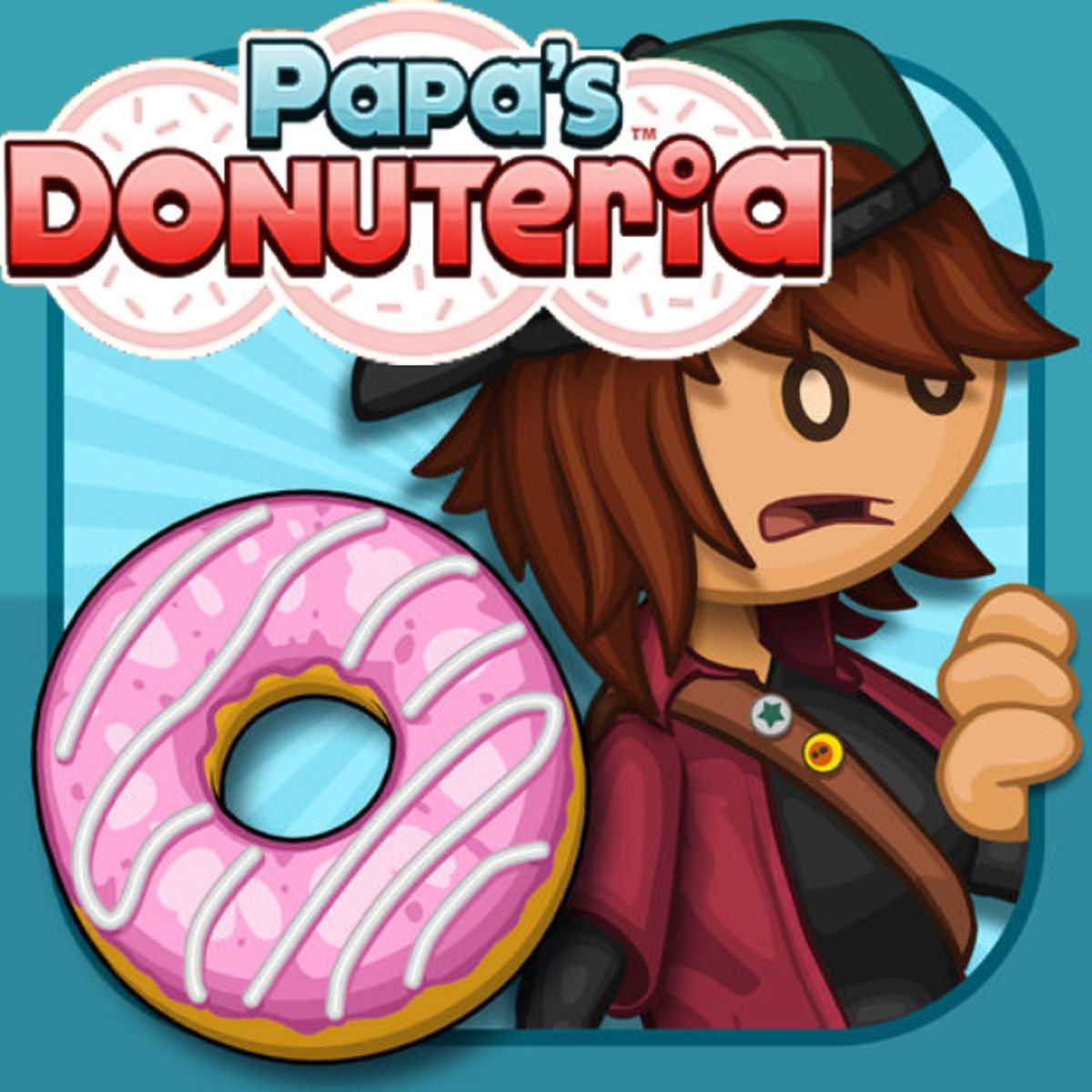



Running a doughnut shop sounds simple until several customers are waiting, one batch is frying, another order still needs toppings, and a new ticket has just appeared. That is the central challenge of Papa’s Donuteria, a time-management cooking game from Flipline Studios set in the colorful amusement park of Powder Point.
Instead of preparing one order from beginning to end before starting another, players gradually learn to manage several tasks at the same time. You take customer orders, prepare the correct doughnut shapes, monitor them while they fry, add fillings and icing, finish them with toppings, and serve each order as accurately as possible.
The individual actions are straightforward. The difficulty comes from coordinating them. As the restaurant becomes busier, timing, accuracy, order management and multitasking become just as important as knowing how to make the doughnuts themselves.
What is Papa’s Donuteria?
Papa’s Donuteria is a restaurant management and cooking game centered on operating a doughnut shop at Powder Point. Like other games in the Papa Louie restaurant series, each working day is divided into customer orders and a sequence of food-preparation stations.
Customers don't simply ask for a generic doughnut. Their tickets specify how the doughnuts should be prepared and decorated, meaning players need to pay attention to shape, cooking, fillings, icing, toppings and other details.
Completing an order accurately contributes to a stronger score and better tips, while mistakes can reduce the final result. This makes precision important even when the restaurant becomes busy.
As you progress, additional customers, ingredients and other content become available, gradually increasing the number of combinations you need to recognize and prepare.
How Papa’s Donuteria gameplay works
The basic gameplay follows a repeating restaurant workflow: take the order, prepare the doughnuts, fry them, decorate them and serve the finished order.
The challenge is that these stages overlap. While one customer's doughnuts are cooking, you may have enough time to begin another order. While another batch is waiting for decoration, a new customer may arrive at the counter.
Managing those overlapping tasks efficiently is the heart of Papa’s Donuteria.
If you concentrate entirely on one station, another part of the restaurant can fall behind. Leave the fryer unattended for too long and the doughnuts may not be cooked correctly. Spend too much time decorating while customers wait at the counter and waiting scores can suffer.
The goal isn't simply to work faster. It is to create a workflow where each station keeps moving without sacrificing accuracy.
Take accurate orders before rushing to the kitchen
Every doughnut begins with the customer's ticket, so mistakes at the beginning can affect the entire order.
Pay attention to the requested doughnut types and how each one should eventually be finished. Once several tickets are active simultaneously, similar orders can become easy to confuse.
A useful habit is to quickly review a ticket before moving to the next preparation step rather than relying entirely on memory.
As the shop becomes busier, order organization becomes increasingly important. Know which customer arrived first, which doughnuts are already frying, which orders still need decoration, and which ticket can be completed quickly.
Good order management prevents a situation where several partially completed meals accumulate at different stations.
Prepare each doughnut carefully
The preparation stage establishes the foundation for everything that follows. If the wrong doughnut is prepared, perfect frying and decoration cannot completely correct the original mistake.
Focus first on matching the customer's requested doughnuts accurately. Speed becomes useful only after you can prepare orders consistently.
When multiple tickets are waiting, look for opportunities to prepare several doughnuts efficiently without losing track of which pieces belong to which customer.
This is where organization begins to matter more than raw clicking speed.
A strong workflow means knowing what is being prepared now and what should happen immediately afterward.
Frying requires attention to timing
The fryer introduces one of the game's most important time-management challenges.
Doughnuts need to be monitored while cooking, and players must handle them at the appropriate points rather than simply placing them in the fryer and forgetting about them.
The difficulty increases when several pieces are cooking while other parts of the restaurant also require attention.
Use the cooking period productively. Instead of staring at the fryer until a doughnut is ready, check another order, begin preparing the next batch, or complete a decoration task that can be finished quickly.
Then return before the cooking process is neglected.
This rhythm is fundamental to Papa’s Donuteria: start a timed task, work elsewhere, return at the right moment.
Learning that cycle can dramatically improve restaurant efficiency.
Decorating is where precision becomes especially important
After cooking, the doughnuts still need to match the customer's requested design. Depending on the order, this can involve fillings, icing, drizzles, sprinkles and other toppings.
This stage rewards controlled placement rather than rushing.
Try to distribute toppings according to the ticket and avoid treating decoration as an afterthought. A perfectly cooked doughnut can still lose points if its finishing details don't match the customer's request.
When working with several doughnuts in the same order, check each one individually. Similar-looking pieces may require different finishes.
The decorating stage is also where visual organization helps. Complete each component methodically instead of jumping randomly between toppings.
Accuracy here can turn an average order into a much stronger one.
Multitasking is the real challenge
Papa’s Donuteria becomes much easier once you stop thinking of each customer as an isolated task.
Suppose one batch has just entered the fryer. Waiting beside it wastes valuable time. Instead, move to another station and continue working until the doughnuts need attention.
Likewise, if an order requires several decorating steps, consider whether another timed task should be started first.
The goal is to reduce periods when nothing productive is happening.
However, multitasking has limits. Starting too many orders simultaneously can become counterproductive if you can no longer remember which doughnuts belong to which customer or when each batch needs attention.
Effective multitasking means keeping enough tasks active to use your time efficiently without creating more work than you can accurately control.
Customer scores show where you need to improve
Scores provide useful feedback about how well you handled different parts of an order.
Instead of looking only at the total result, pay attention to where points are being lost repeatedly. If waiting performance is weak, your workflow between customers may be too slow. If cooking results are inconsistent, you may be leaving the fryer unattended for too long. If finishing scores are lower, slow down slightly when applying toppings.
This turns scoring into a diagnostic tool.
Don't try to improve everything at once. Identify the station causing the largest recurring problem and concentrate on it for several in-game days.
Once that stage becomes more reliable, move to the next weakness.
This approach is more useful than simply trying to click faster during every shift.
Use upgrades to remove bottlenecks
Tips and earnings can be reinvested into the restaurant through available upgrades and decorations.
The best upgrade isn't necessarily the most expensive one. Prioritize improvements that solve a problem you're actually experiencing.
If you frequently lose track of timed tasks, equipment that makes those tasks easier to monitor may provide immediate value. If customer waiting is becoming the main weakness, lobby improvements can become more useful.
Think of upgrades as tools for improving workflow rather than collectibles that need to be purchased in a fixed order.
Before spending, ask yourself: Which part of my current shift causes the most lost time or mistakes?
Investing around that answer usually produces a more noticeable benefit.
New ingredients make later orders more complex
Progression introduces additional ingredients and combinations, including seasonal content associated with holidays.
New ingredients don't fundamentally change the core workflow, but they increase the amount of information players need to recognize.
An early order may be easy to remember because only a limited selection of ingredients is available. Later, more possible combinations mean tickets require closer attention.
Holiday ingredients also change the visual appearance of the menu and give customers different seasonal combinations.
When something new unlocks, take a moment to identify where it appears in the preparation process before trying to handle it at full speed.
Learning each new ingredient as it arrives is easier than waiting until several unfamiliar options have accumulated.
A practical strategy for busy shifts
When several customers are active, prioritize timed tasks and nearly completed orders.
Start doughnuts cooking, then use that cooking window to perform another action. If an order needs only one or two final toppings before it can be served, finishing it may be more efficient than beginning another complicated ticket.
Avoid letting too many unfinished orders accumulate.
A practical workflow is to keep the fryer active while advancing another ticket through preparation or decoration. Check cooking progress regularly, return when needed, then continue with the next available task.
You should also avoid automatically serving orders in the exact sequence in which every individual task was started. Consider which order can be completed efficiently without allowing another customer's wait to become excessive.
The objective is to maintain a smooth flow through the entire restaurant rather than maximizing the speed of only one station.
Common mistakes new players should avoid
One of the biggest mistakes is finishing every customer completely before beginning another order. This feels organized, but it wastes the periods when doughnuts are cooking and can create a long line at the counter.
The opposite mistake is starting too many orders at once. Multitasking helps only while you can still track every active task.
Another common problem is focusing on speed at the expense of accuracy. Preparing the wrong item or applying incorrect toppings can erase the advantage gained from finishing a few seconds earlier.
Players should also avoid forgetting the fryer while decorating. Detailed toppings can demand attention, making it easy to lose track of cooking progress.
Finally, don't buy upgrades without considering your current weakness. An upgrade that solves a frequent problem is usually more useful than one that has little effect on your normal workflow.
Tips for better scores in Papa’s Donuteria
Start with accuracy. Learn the preparation process and understand what each part of the customer ticket means before trying to become faster.
Next, use cooking time efficiently. The fryer creates natural windows in which you can take another order, prepare another batch, or continue decorating.
Keep tickets organized and check them frequently. When several similar doughnuts are being prepared, relying entirely on memory increases the chance of mixing up orders.
Improve one station at a time. If your cooking performance is already consistent but decoration scores remain lower, concentrate your practice there rather than trying to change your entire workflow.
Finally, develop a repeatable rhythm. Experienced play is less about frantic movement and more about knowing what the next useful action should be.
Who should play Papa’s Donuteria?
Papa’s Donuteria is particularly suitable for players who enjoy cooking games, restaurant management, time-management challenges and the Papa Louie series.
The basic controls and food-preparation steps are approachable, while increasingly busy shifts provide more challenge as players progress.
It can appeal to players who enjoy decorating food because doughnut customization is an important part of each order. At the same time, players interested in optimization can concentrate on workflow, customer waiting, cooking timing and upgrade choices.
Those looking for combat or exploration won't find those systems here. Papa’s Donuteria stays focused on running the restaurant and improving the efficiency and accuracy of each working day.
That focused structure is what gives the game its identity.
Papa’s Donuteria FAQ
What type of game is Papa’s Donuteria?
Papa’s Donuteria is a cooking and time-management game where players operate a doughnut shop and complete customized customer orders.
Where does Papa’s Donuteria take place?
The game is set at Powder Point, a seaside amusement park that provides the setting for the doughnut shop.
What do you do in Papa’s Donuteria?
Players take orders, prepare doughnuts, cook them in the fryer, add fillings and toppings, serve customers, and manage multiple orders during each shift.
What is the most important skill for beginners?
Accuracy should come first. Once you can reliably prepare orders correctly, begin improving multitasking and speed.
How can I manage several orders at once?
Use cooking periods to complete other tasks. Start a timed process, work at another station, and return before the doughnuts require attention.
Should I buy upgrades immediately?
Prioritize upgrades that address an actual weakness in your workflow, such as difficulty monitoring timed tasks or managing customer waiting.
Final thoughts
Papa’s Donuteria looks like a straightforward doughnut-making game, but its real challenge comes from coordinating an increasingly busy restaurant.
Taking an order is easy. Preparing a doughnut is easy. Frying one batch is manageable. Decorating a single order isn't particularly complicated. The difficulty appears when all of those jobs need attention at nearly the same time.
Improvement therefore comes from building a better workflow rather than simply moving faster. Keep timed tasks active, use waiting periods productively, monitor the fryer, organize customer tickets, decorate accurately, and invest in upgrades that remove the weaknesses slowing down your restaurant.
Once those habits begin working together, Papa’s Donuteria becomes less about rushing from station to station and more about keeping the entire shop moving smoothly from the first customer to the last.