






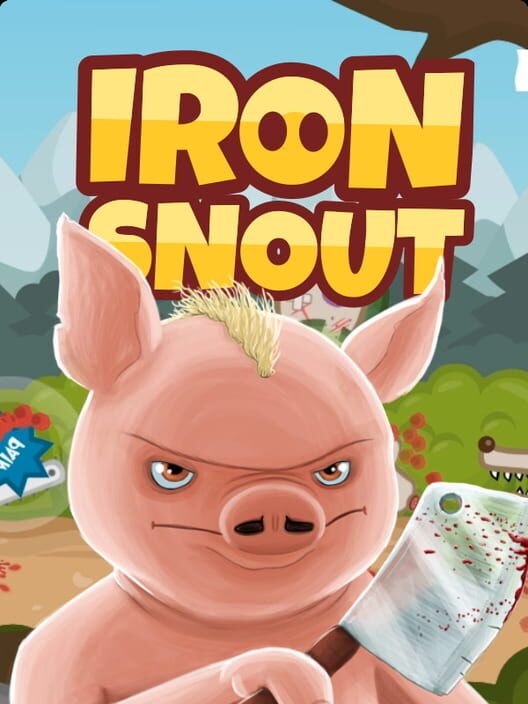




Iron Snout starts with an intentionally simple setup: one pig in the middle of the screen and wolves attacking from both directions. There is no complicated battlefield to explore or lengthy preparation phase. The challenge is to react to whatever reaches you next.
That simplicity quickly turns into chaos. Wolves approach from the left and right, different attacks require different reactions, and weapons can enter the fight. The supplied game description specifically mentions axes, chainsaws and rockets, with some enemy weapons capable of being turned against the attackers.
The result is a compact arcade fighting game built around timing, positioning, reactions and survival. Learning the controls takes little time. Surviving when several threats arrive together is where the real challenge begins.
What is Iron Snout?
Iron Snout is an arcade-style fighting game where you control a cartoon pig fighting waves of attacking wolves. Instead of moving through traditional side-scrolling levels, much of the action is concentrated around the pig's position while enemies approach from both sides.
The basic objective is survival. Wolves continue entering the fight, and the player responds using attacks, jumps, defensive movements and other available actions. The longer the run continues, the more demanding it becomes to track threats coming from different directions.
This structure removes many systems normally associated with fighting games. You don't need to memorize a long character roster or spend time exploring a map before combat begins. The game quickly puts its central mechanic in front of you: read the attack and respond correctly.
That makes Iron Snout accessible at first, while still leaving room for improvement through better reactions and timing.
How Iron Snout gameplay works
Iron Snout revolves around fighting enemies arriving from the left and right. According to the supplied description, the basic actions include attacking in either direction, jumping to avoid threats and ducking beneath certain attacks.
These controls sound straightforward when only one wolf is attacking. The difficulty increases when different threats overlap.
You may need to strike an enemy on one side and immediately respond to an attack coming from the opposite direction. A projectile can force another reaction before you have fully dealt with the first wolf.
This makes awareness extremely important. Watching only one side of the screen can leave you vulnerable to an enemy entering from the other.
Instead of pressing attacks continuously, try to read what is happening around the pig and choose the action appropriate to the immediate threat.
Combat is built around timing and reactions
Iron Snout doesn't require players to memorize complicated fighting-game command sequences before they can perform useful attacks. The supplied material describes attacks as naturally chaining into combos, allowing the player to move between actions as enemies continue approaching.
This doesn't mean random button pressing is always effective.
Timing matters because every attack occurs within an active battlefield. If you commit attention to one enemy while another is approaching from behind, a successful hit can still leave you exposed.
A better approach is to treat each attack as part of a sequence. Strike the immediate threat, identify where the next enemy is coming from, then prepare the next response.
As the pace increases, this process happens faster. The challenge isn't simply attacking more quickly. It is making correct decisions with less time available.
Watch both sides of the screen
One of the most important habits in Iron Snout is maintaining awareness of both directions.
The pig fights near the center while enemies can approach from either side. Focusing entirely on one wolf creates tunnel vision and makes attacks from the opposite direction much harder to react to.
Try to monitor movement near both edges rather than staring only at the enemy directly in front of you. Early visual information gives you more time to determine what kind of response is needed.
This becomes especially important once multiple enemies are active. The supplied description notes that later moments can involve several attackers and weapons coming from both directions simultaneously.
The sooner you recognize the next threat, the less likely you are to panic when it reaches the pig.
Enemy weapons can become your weapons
Weapons add another layer to Iron Snout's combat.
The supplied game information mentions axes, chainsaws and rockets among the threats used by enemies. More importantly, some weapons can be caught, redirected or used against the wolves themselves.
This changes how you should think about incoming attacks.
A projectile isn't always just something to avoid. Under the right circumstances, it can become an opportunity to damage another enemy. Catching or redirecting a weapon effectively can transform a defensive moment into an offensive one.
For example, immediately avoiding every thrown object may keep you safe, but learning which threats can be turned against enemies gives you another way to control crowded situations.
Don't waste these opportunities by reacting automatically. Learn what each weapon does and how the game allows you to interact with it.
Combos become easier when you stop button-mashing
Longer attack sequences can look impressive, but successful combos are more useful when they emerge from good reactions rather than random inputs.
The first priority should always be surviving the immediate threat. Once you become comfortable recognizing attacks, combinations begin to flow more naturally because you're responding faster and moving between enemies without unnecessary pauses.
Think of a combo as a chain of correct decisions.
An enemy approaches from the left, so you respond. Another enters from the right, so you change direction. A weapon appears, and you decide whether to avoid it or use it. When those actions connect smoothly, the result becomes a longer combat sequence.
This approach is more reliable than simply trying to attack as quickly as possible.
Learn when to jump and when to duck
Attacking isn't your only response. Jumping and ducking provide important defensive options, particularly when different types of threats begin appearing.
The key is not to use these movements randomly.
Every defensive action should answer a specific attack. Jumping unnecessarily can put you in an awkward position when the next enemy arrives. Ducking without reading the threat can similarly leave you unprepared for another attack.
Pay attention to enemy animations and projectile paths. With repeated play, you can begin recognizing which situations call for an attack, jump, duck or another reaction.
This pattern recognition reduces the amount of conscious decision-making required. Instead of thinking through every response from the beginning, you begin reacting to familiar situations more naturally.
Surviving longer changes the challenge
Iron Snout becomes harder as a run continues. The supplied material describes increasing chaos involving multiple enemies, weapons from both directions and increasingly tight reaction windows.
This means a strategy that works during the opening moments may become less reliable later.
Early on, you can often concentrate on individual enemies. During more crowded sequences, you need to think about the entire screen.
Threat priority becomes important. An enemy immediately about to hit you usually deserves attention before one that is still farther away. A projectile may require a response before another wolf reaches attack range.
As the screen becomes busier, don't try to process every object equally. Identify the most immediate danger first, deal with it, then move to the next threat.
Learn enemy patterns instead of relying only on reflexes
Fast reactions help, but Iron Snout isn't purely about reflex speed.
Repeated encounters allow you to become familiar with enemy behavior. You begin recognizing how certain attacks start, how projectiles travel, and how much time you have before an enemy becomes dangerous.
This makes later runs more manageable because you aren't seeing every situation for the first time.
Instead of reacting only when an attack is already close, watch the beginning of the animation. Early recognition gives you additional time to choose the correct response.
The source itself recommends learning enemy patterns as a way to improve survival.
The more patterns you recognize, the less dependent you become on last-second reactions.
How to improve your survival time
Start by prioritizing accuracy over attack speed. Constantly pressing attacks may work against simple situations, but controlled responses become more valuable when several threats overlap.
Next, train yourself to look at both sides of the screen. This is arguably more important than learning elaborate combinations because an attack you don't notice is much harder to counter.
Use enemy weapons intelligently. If the game gives you an opportunity to catch, redirect or throw something back, consider how that weapon can help against another approaching enemy.
Stay aware of spacing as well. The most dangerous situations often occur when several threats reach you almost simultaneously. Responding to the closest threat quickly can create enough room to deal with the next one.
Finally, don't judge improvement only by flashy combos. Surviving longer and responding more consistently are better signs that your combat awareness is improving.
Common mistakes new players should avoid
The first common mistake is button-mashing. Iron Snout is fast, but speed without timing can lead to unnecessary errors. A controlled response is usually more useful than attacking simply because an enemy is visible.
Tunnel vision is another major problem. Players may concentrate on a wolf directly in front of the pig and fail to notice another approaching from behind.
Ignoring weapons can also make fights harder than necessary. Some incoming weapons aren't merely hazards. Understanding how to use them against enemies adds another tool to your combat options.
Panic becomes another issue during crowded moments. When several enemies and projectiles appear together, randomly changing actions can make the situation worse. Deal with the most immediate threat first.
Finally, don't repeat the same mistake without examining what happened. If a particular enemy or projectile repeatedly ends your run, focus on learning that specific attack.
High-score runs require consistency
Iron Snout's score-based structure gives players a straightforward reason to improve: survive longer and perform better than in previous attempts.
A strong run doesn't depend on one impressive moment. It requires maintaining concentration as the battle becomes increasingly demanding.
This is where consistency matters.
A player who performs several complicated combinations but frequently misses attacks from behind may struggle to survive. Another player using simpler actions with stronger awareness can remain in the fight longer.
When chasing a better score, focus first on reducing avoidable mistakes. Once your basic survival becomes reliable, more aggressive play and longer combos can follow naturally.
The objective isn't to create the most complicated sequence possible. It is to keep the pig fighting.
Why Iron Snout works well for short sessions
Iron Snout gets into combat quickly. The source emphasizes that there is little setup before the fighting begins, making individual runs suitable for players who want an arcade game they can start without a lengthy introduction.
That structure also makes restarting straightforward. A failed attempt doesn't require repeating a long level before returning to the main challenge.
Instead, each run becomes another opportunity to improve a reaction, recognize an enemy pattern or push the score slightly higher.
This is one of the practical strengths of simple arcade design. Players can understand the objective quickly while still having room to develop better timing and awareness over repeated attempts.
Visual clarity matters in a fast fighting game
Iron Snout uses bright cartoon visuals rather than realistic graphics. That style fits the deliberately absurd premise of a pig fighting armed wolves, but it also serves a practical gameplay purpose.
In a fast reflex game, players need to identify enemies and attacks quickly.
The supplied description emphasizes bright colors, clear enemy animations and responsive movement.
Clear animations can help players distinguish an ordinary enemy approach from an incoming attack or projectile. That visual information becomes increasingly valuable when several objects are moving across the screen simultaneously.
The playful art direction therefore supports the combat rather than simply decorating it.
Who should play Iron Snout?
Iron Snout is best suited to players who enjoy arcade action, fighting games, reflex challenges and score-based gameplay.
Its basic concept is easy to understand, so players don't need extensive fighting-game experience before starting. The challenge comes from improving reactions and dealing with increasingly busy combat situations.
It also suits players who prefer short rounds rather than long missions or story-heavy campaigns. You can start fighting quickly, attempt to improve your performance, and begin another run after losing.
Players looking for extensive exploration, a deep narrative or complex long-term progression may find the design comparatively simple. Iron Snout focuses much more heavily on its core combat loop.
For players who enjoy mastering a small set of mechanics, however, that simplicity is precisely where the challenge comes from.
Final thoughts
Iron Snout takes an unusually simple premise and builds a focused arcade fighting game around it: a pig stands against wave after wave of wolves.
The controls aren't the difficult part. The challenge comes from using them correctly when enemies attack from both directions, weapons begin flying across the screen, and several threats demand attention almost simultaneously.
Learning to attack is only the beginning. Better runs require you to watch both sides, recognize enemy patterns, use jumps and ducks at the right moments, turn enemy weapons against them, and stay composed as the pace increases.
That makes the path to improvement straightforward: react less randomly, recognize threats earlier, and make every action more deliberate.