



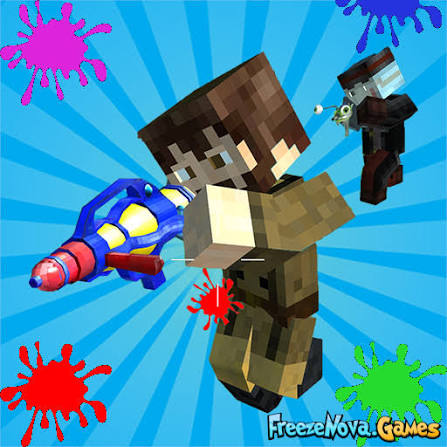


Xtreme Paintball Wars takes the familiar structure of a first-person shooter and gives it a more colorful identity. Instead of conventional bullets and realistic military environments, players fight with paintball weapons inside bright 3D pixel-style battlefields.
The presentation may look playful, but the fundamental FPS skills still matter. Players need to aim accurately, keep moving, use the environment, understand engagement distance, and react to opponents before they can return fire. The game supports both single-player battles against AI and multiplayer matches with other players.
That combination makes Xtreme Paintball Wars relatively easy to understand while still giving players several areas to improve. Learning how to shoot is only the beginning. Better performance comes from understanding where to move, when to engage, which weapon suits the situation, and how to use the map instead of simply running toward every opponent.
What is Xtreme Paintball Wars?
Xtreme Paintball Wars is a 3D pixel-style first-person shooter built around paintball combat. Players enter arenas, equip paintball weapons, and attempt to eliminate opponents while navigating maps filled with walls, pathways, obstacles, and potential fighting positions.
The game offers two broad ways to play. Single-player mode provides AI-controlled opponents, while multiplayer allows matches involving other players. The source also describes character selection, teams, multiple maps, and different game modes.
The paintball theme changes the visual identity of the game without removing the core FPS mechanics. Accuracy still matters. Positioning still matters. Standing in an exposed area can still make you an easy target, while understanding the map can give you better opportunities to attack.
For new players, the most useful approach is to learn these fundamentals before worrying about aggressive tactics.
How Xtreme Paintball Wars gameplay works
A typical match begins by selecting the available mode, character or team and entering the battlefield. From there, gameplay revolves around locating opponents, aiming, firing, moving between positions, and avoiding enemy attacks.
The basic controls listed in the supplied material are straightforward: WASD or Arrow keys for movement, left-click to shoot, right-click to aim, Spacebar to jump, Shift to sprint, R to reload, and number keys to switch weapons.
Simple controls don't necessarily produce simple matches. The challenge comes from combining them effectively.
Moving without checking corners can lead directly into an opponent. Shooting without controlling your aim can reveal your position without securing an elimination. Reloading in an exposed area can leave you unable to respond.
The better you become at connecting movement, aiming, cover, and weapon management, the more controlled each encounter becomes.
Aim and movement should work together
Accuracy is one of the central skills in Xtreme Paintball Wars. The source specifically identifies precision shooting as an important gameplay mechanic, but good aim becomes much more useful when combined with effective movement.
Standing still may make aiming easier for a moment, but it can also make you easier for opponents to hit. Constantly moving without controlling your crosshair creates the opposite problem: you're harder to target, but your own shots become less reliable.
Try to balance the two.
Move while searching for enemies, then control your movement when you're ready to take a more accurate shot. After firing, reposition rather than remaining in exactly the same place.
This prevents opponents from repeatedly aiming at a predictable location and makes your movement serve a tactical purpose instead of becoming random motion.
Positioning can win fights before the first shot
Aiming receives most of the attention in FPS games, but positioning often determines how difficult a fight will be.
If you enter an engagement from an exposed area, your opponent may have a clear shot before you can react. If you approach from behind cover or from a stronger angle, you give yourself more time to aim and less of your character is exposed.
Walls and other obstacles can therefore become important defensive tools. The source specifically recommends using cover rather than remaining in open areas.
Avoid treating cover as a place where you permanently hide. Use it as a temporary position from which you can observe, attack, reload, and then move again.
A good position should give you useful visibility while reducing how easily opponents can attack you.
Learn the maps instead of running randomly
Map knowledge becomes increasingly useful after you've played the same battlefield several times.
During your first matches, pay attention to pathways, open spaces, obstacles, corners, and areas where fights frequently occur. Notice where opponents tend to appear and which routes leave you exposed for too long.
The source recommends learning maps and controlling high-traffic areas as part of stronger play.
Knowing the map reduces uncertainty. Instead of entering every area without knowing what is ahead, you begin anticipating where another player may appear.
This also helps with positioning. If you know a particular path regularly leads into a busy combat zone, you can approach it carefully rather than sprinting directly into the center.
Map knowledge doesn't replace good aim, but it can create easier shots.
Choose weapons around engagement distance
Xtreme Paintball Wars includes different paintball weapons rather than forcing players to use one identical gun throughout every encounter. The source groups them broadly into rapid-fire weapons, higher-impact options, and more balanced rifles.
This makes weapon choice part of your strategy.
A weapon suited to rapid close-range fighting may not feel as effective when you're repeatedly engaging opponents from farther away. Similarly, a weapon that rewards more deliberate shots can become uncomfortable when enemies suddenly appear at close range.
Before choosing or switching weapons, think about where most of your current fights are happening.
If you're moving through tight spaces and encountering enemies suddenly, prioritize equipment that feels manageable in close engagements. If the map creates longer sightlines, a weapon that supports more controlled shooting may be more useful.
Don't judge a weapon only by apparent power. The best choice is the one that fits the range and situation you're actually facing.
Understand the main game modes
The source describes several modes, including Deathmatch, Team Deathmatch, Zombie Mode, and custom matches. Each changes what players should prioritize.
In Deathmatch, individual survival and eliminations become especially important because every player operates primarily for themselves. You need to watch multiple directions and avoid assuming another nearby player is friendly.
Team Deathmatch changes that dynamic. Working around teammates can create better opportunities than repeatedly entering fights alone. If several teammates are already attacking one area, supporting them may be more useful than disappearing to another part of the map in search of individual eliminations.
Zombie Mode shifts the focus toward survival-style encounters, requiring players to deal with waves of enemies rather than approaching combat exactly like a standard player-versus-player match.
Custom matches provide additional flexibility through selectable maps, modes, and player settings as described by the source.
Use single-player mode to practice fundamentals
Players don't need to begin with multiplayer competition. Xtreme Paintball Wars also provides a single-player option against AI-controlled opponents.
This can be useful for learning basic mechanics without immediately dealing with the unpredictability of other players.
Use these matches to practice aiming while moving, test different weapons, become familiar with controls, and explore maps.
Don't focus only on winning. Pay attention to whether you can keep your crosshair controlled while moving, whether you remember to reload before entering another engagement, and whether you're using obstacles effectively.
Once these actions become more natural, multiplayer matches become easier to read because you can spend less attention thinking about basic controls.
Team play requires more than chasing eliminations
In team-based matches, individual eliminations matter, but constantly separating from teammates can make encounters unnecessarily difficult.
Try to maintain awareness of where your team is operating. Fighting near teammates can create situations where several players can pressure the same opponent or cover different approaches.
This doesn't mean everyone should stand in exactly the same place. Spreading out slightly can provide better coverage while still allowing players to support each other.
Also pay attention to what the match actually requires. The source specifically recommends playing the objective rather than focusing only on eliminations in team modes.
A player with strong aim can still hurt the team's chances by ignoring the objective entirely.
Reload before you expose yourself
Reloading is a small action that can create a large vulnerability.
If you enter an exposed area and discover that your weapon needs to reload, an opponent may have several seconds to attack while you cannot respond effectively.
Develop the habit of checking ammunition before leaving cover or entering an area where combat is likely.
When possible, reload behind an obstacle or during a quieter moment rather than waiting until the weapon becomes empty during a firefight.
This is particularly important after an engagement. Players often eliminate one opponent and immediately sprint forward without preparing for the next fight.
Use the brief moment after a successful encounter to check your weapon, surroundings, and next route.
Don't stay in the same position for too long
Cover is valuable, but predictable positioning can become dangerous.
If you repeatedly attack from the same corner, opponents may begin anticipating where you'll appear. Even a strong defensive location loses much of its value once the enemy knows exactly where to aim.
After an engagement, consider changing position.
The move doesn't need to be dramatic. Shifting to another piece of cover or approaching from a different angle can be enough to make your next appearance less predictable.
The source emphasizes movement, repositioning, anticipating enemy movement, and adapting your playstyle.
Good FPS movement isn't about running constantly. It is about being difficult to predict.
Common mistakes new players should avoid
One common mistake is remaining completely still while shooting. This may make aiming feel easier, but it also gives opponents a predictable target. Learn to combine controlled movement with accurate fire.
Another mistake is sprinting everywhere. Sprinting can help you move across the map quickly, but entering a dangerous area at full speed can leave you less prepared for an immediate encounter.
Players should also avoid ignoring cover. Running through the center of open areas makes you visible from several directions and can turn even a simple fight into a disadvantage.
Poor weapon selection is another problem. If your current weapon repeatedly performs poorly at the distance where you're fighting, adjust either your weapon or your positioning.
Finally, don't focus exclusively on the opponent directly in front of you. Another enemy may be approaching from a different direction, particularly in free-for-all or busy multiplayer matches.
Practical tips for better matches
Start by improving crosshair discipline. Keep your aim near areas where an opponent is likely to appear instead of pointing at the floor or moving the camera randomly.
Second, learn one map at a time. Remember important routes, cover positions, open areas, and locations where engagements occur frequently.
Third, avoid unnecessary fights. If you're badly positioned or need to reload, moving behind cover may be smarter than forcing an engagement immediately.
Fourth, match your weapon to your preferred range. If you enjoy aggressive close-range movement, choose accordingly. If you're more comfortable controlling angles and firing deliberately, use a weapon that supports that approach.
Finally, adapt during the match. The source specifically notes that one aggressive tactic will not work in every situation. If opponents repeatedly counter your approach, change your route, distance, weapon, or position rather than repeating the same unsuccessful attack.
Who should play Xtreme Paintball Wars?
Xtreme Paintball Wars is most suitable for players who enjoy FPS games, paintball combat, pixel-style graphics, multiplayer matches, and quick action-oriented gameplay.
The basic controls make the game approachable for players who already understand standard browser FPS movement. At the same time, skills such as map knowledge, aim, positioning, weapon selection, and team awareness provide areas for continued improvement.
Players who prefer solo play can use the AI mode, while those looking for less predictable competition can move into multiplayer.
Its colorful presentation also gives it a different visual tone from military-style shooters. The core gameplay still relies on familiar FPS fundamentals, but the paintball theme makes the battlefield deliberately brighter and more playful.
Xtreme Paintball Wars FAQ
What type of game is Xtreme Paintball Wars?
It is a 3D pixel-style first-person shooter centered on paintball combat.
Can you play against AI?
Yes. The supplied game information describes a single-player mode where players can fight AI-controlled opponents and practice basic skills.
Does Xtreme Paintball Wars have multiplayer?
Yes. Multiplayer is included, with the source describing online matches and options for custom games.
What game modes are available?
The supplied material lists Deathmatch, Team Deathmatch, Zombie Mode, and custom matches.
What are the basic controls?
Movement uses WASD or Arrow keys. Left-click shoots, right-click aims, Spacebar jumps, Shift sprints, R reloads, and number keys switch weapons.
What should beginners practice first?
Start with aim, movement, map awareness, cover use, and reload timing. Once those fundamentals feel comfortable, focus more heavily on weapon selection and predicting enemy movement.
Final thoughts
Xtreme Paintball Wars gives traditional FPS mechanics a colorful paintball presentation, but winning still depends on familiar shooting fundamentals.
Good aim helps, but aim alone isn't enough. Players also need to move intelligently, use cover, learn maps, understand weapon ranges, reload safely, and adapt when opponents begin anticipating their strategy.
Single-player matches provide a place to practice those skills against AI, while multiplayer introduces less predictable opponents and a greater need for awareness and adaptation. Different modes further change how you should approach each match.
The simplest way to improve is not to chase every opponent you see. Control your movement, choose better positions, take cleaner fights, and make each engagement happen on terms that favor you.