








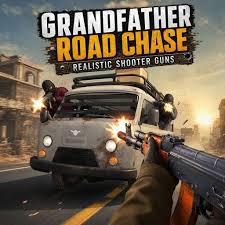



Most shooting games ask you to move through a battlefield. Grandfather Road Chase Shooter changes that formula by putting the battlefield in motion.
You fight from a vehicle traveling along the road while enemies pursue from behind. Instead of controlling every aspect of the vehicle, your attention is concentrated on combat: identify approaching threats, aim, fire, manage ammunition, choose the right weapon, and eliminate enemies before they can overwhelm you.
That creates a simple but demanding gameplay loop. The road keeps moving, enemy vehicles continue approaching, and there is little time to hesitate when several threats appear together. Success depends less on exploration and more on aiming, reaction time, target priority, weapon management, and knowing when to reload.
What is Grandfather Road Chase Shooter?
Grandfather Road Chase Shooter is an action shooting game built around high-speed vehicle pursuits. Rather than fighting from a fixed position or exploring a large FPS map on foot, the player participates in combat while traveling in a moving vehicle.
Enemy vehicles pursue you along the road, creating a constantly changing battlefield. Your main task is to attack those threats before they can cause too much damage or get into dangerous positions.
The basic objective is easy to understand: survive the chase and eliminate the enemies pursuing you.
The challenge comes from performing that task while everything is moving. Distance between vehicles changes constantly, several targets may appear at once, and ammunition management can leave you vulnerable if you reload at the wrong moment.
How Grandfather Road Chase Shooter gameplay works
The core gameplay revolves around aiming at pursuing enemies and using your available weapons to stop them.
Because the vehicle continues moving, combat feels different from a conventional stationary shooting gallery. An enemy that is far away now may become an immediate threat only seconds later, so players need to judge both distance and danger.
This makes target selection important. Shooting whichever enemy happens to be closest to the crosshair isn't always the best approach. A rapidly approaching vehicle or heavily armed enemy may deserve attention before a weaker target that poses less immediate danger.
Weapons also introduce another decision. Different firearms can perform better in different situations, while ammunition and reload timing determine whether that firepower is actually available when you need it.
The overall loop becomes: identify the threat, aim, fire, reassess the road, reload when safe, and prepare for the next attack.
The moving road changes how you aim
A moving chase creates a different aiming challenge from a traditional shooter.
Your target isn't simply standing at a predictable distance. Enemy vehicles can approach from behind while the chase continues forward, meaning their relative position changes throughout the encounter.
Instead of constantly moving your aim between every visible enemy, try to identify the most dangerous target first and stay focused long enough to deal meaningful damage.
Rapidly switching targets can result in several damaged enemies remaining active at the same time.
It is often more useful to remove one immediate threat and then move to the next. This reduces the number of active attackers and makes the battlefield easier to read.
Accuracy therefore matters, but target discipline can be just as important.
Learn which enemies should be attacked first
Not every enemy on the road represents the same level of danger.
When several vehicles are pursuing you, look at their distance, speed, position, and offensive threat. An enemy closing the gap quickly may need to be eliminated before one that remains farther behind.
This creates a simple priority system. Deal with threats that can hurt you soon, then use the available time to attack less urgent targets.
Avoid tunnel vision. Spending too long trying to destroy one difficult enemy can allow another vehicle to move into a much more dangerous position.
After every few shots, quickly scan the chase again. Has another vehicle moved closer? Is a new attacker entering the fight? Do you still have enough ammunition to finish the current target?
Those small reassessments can prevent a manageable chase from suddenly becoming crowded.
Reload timing can decide a chase
Reloading is easy when nothing is happening. It becomes much more dangerous when an enemy is already close.
One of the most useful habits in Grandfather Road Chase Shooter is learning to reload during quieter moments instead of waiting until the weapon is completely empty in the middle of an attack.
Pay attention to ammunition while shooting. If the immediate threat has been eliminated and the next enemy is still at a safe distance, that can be a good opportunity to prepare a fresh magazine.
This reduces the chance of hearing an empty weapon at exactly the wrong moment.
At the same time, avoid reloading automatically after firing only a few rounds if another dangerous target is already approaching. Sometimes the ammunition remaining in the weapon is enough to eliminate that enemy first.
Think of reloading as a tactical decision rather than a routine animation.
Different weapons can change your approach
Grandfather Road Chase Shooter includes multiple weapons, giving players different ways to deal with pursuing enemies. The supplied description mentions options such as assault rifles, heavy machine guns, flamethrowers, and miniguns.
The important difference isn't simply that one weapon looks more powerful. Weapon choice can affect how you approach different combat situations.
A firearm suited to controlled fire may be useful when accuracy matters, while weapons capable of sustained damage can become more useful when several threats are close together.
Don't switch weapons only because a newly unlocked option appears stronger. Consider what is actually causing problems during a level.
If enemies are difficult to hit consistently, a weapon that helps you maintain reliable damage may be more valuable. If groups of threats are overwhelming you, heavier firepower may provide a better solution.
Understanding when to use a weapon is more useful than simply owning it.
Don't waste ammunition on poor shots
Continuous firing can feel appropriate during a high-speed chase, but unnecessary shots can create problems later.
Every missed shot brings you closer to another reload. If that reload begins just as a dangerous enemy closes the distance, wasted ammunition suddenly becomes expensive.
Instead, try to fire when the crosshair is positioned effectively on the target. Controlled shooting can conserve ammunition while maintaining useful damage.
This becomes increasingly important when several enemies appear in sequence. Finishing the first vehicle efficiently leaves more ammunition available for whatever follows.
Accuracy and ammunition management therefore support each other. Better shots mean fewer wasted rounds, and fewer wasted rounds mean safer reload timing.
Weapon upgrades should solve a problem
Progression in a shooting game often encourages players to purchase stronger equipment whenever it becomes available. A more useful strategy is to ask what currently limits your performance.
Are enemies taking too long to destroy? Damage may be the problem. Are you reloading constantly? Ammunition capacity or another related improvement may deserve attention. Are later encounters becoming difficult because several threats remain active simultaneously? Improving overall combat efficiency may be more valuable than buying something simply because it is new.
This is particularly important when upgrade resources are limited.
Spreading currency across every available option can leave all of them only slightly improved. Concentrating resources on an important weakness may produce a more noticeable difference.
Upgrade decisions should support your play rather than replace it. Stronger equipment helps, but poor target selection and badly timed reloads can still create difficult situations.
Surviving multiple vehicles requires threat management
A single enemy is relatively easy to track. Several vehicles create a much more complicated situation because they may approach at different speeds and distances.
Don't distribute damage randomly across every target.
Identify the enemy most likely to become dangerous first. Concentrate enough fire to remove it, then immediately reassess the remaining vehicles.
This gradually reduces pressure.
If you damage five enemies but destroy none of them, you may still have five active threats attacking or pursuing you. Eliminating one completely can be more valuable because it immediately reduces the number of problems you need to monitor.
This principle becomes especially useful during more crowded chase sequences.
How to handle harder levels
As the game becomes more demanding, relying entirely on reaction speed becomes less effective. You need a repeatable combat routine.
Start each encounter by scanning the available targets rather than immediately firing. Identify the closest or most dangerous threat and begin there.
Keep an eye on ammunition while attacking. If the current target is almost defeated, consider finishing it before reloading. If the road temporarily becomes safer, use that opportunity to prepare for the next group.
Switch weapons when the situation actually requires a different type of firepower rather than constantly changing equipment.
Most importantly, avoid panic firing. Harder encounters can place more information on screen, but random shooting usually wastes ammunition and makes reload management worse.
The faster the action becomes, the more valuable controlled decisions become.
Common mistakes new players should avoid
The first mistake is shooting at every target equally. When multiple enemies are present, prioritize the ones that pose the most immediate danger.
The second is ignoring ammunition until the weapon is empty. Check your remaining rounds and use safer moments to reload whenever possible.
Another common mistake is assuming a more powerful weapon automatically solves every problem. Firepower matters, but accuracy, reload timing and target priority remain important.
Players can also become too focused on a single enemy. If one vehicle is taking a long time to destroy, periodically check whether another attacker has moved closer.
Finally, avoid firing continuously when the aim isn't properly positioned. Wasted ammunition creates more reloads, and unnecessary reloads create more moments when you cannot respond effectively.
A simple strategy for improving your runs
A useful way to improve is to focus on one skill at a time instead of trying to become faster at everything simultaneously.
First, work on accuracy. Try to reduce unnecessary shots and keep your aim on one target more consistently.
Next, improve reload awareness. Begin noticing safe moments between threats rather than waiting for the weapon to empty automatically.
Then work on target priority. When several enemies appear, consciously decide which one needs to be removed first.
After those habits become more natural, begin experimenting more with weapon switching and upgrades.
This progression works because each skill supports the next. Better accuracy improves ammunition efficiency. Better ammunition management reduces dangerous reloads. Better threat recognition helps you use that ammunition against the enemies that matter most.
Why the chase format changes the shooting experience
The road-chase structure is what separates Grandfather Road Chase Shooter from a more conventional shooting game.
Because the environment is continuously moving, distance becomes part of the pressure. An enemy isn't simply alive or defeated. It can also be approaching, falling behind, or moving into a position where it becomes much more dangerous.
The player also doesn't have the same freedom to search for cover or carefully reposition around an arena. Combat is driven forward by the chase.
That keeps attention focused on what is happening behind and around the vehicle.
The result is a shooting experience built less around exploration and more around continuous threat assessment.
Who should play Grandfather Road Chase Shooter?
Grandfather Road Chase Shooter is best suited to players who enjoy shooting games, car chases, vehicle combat and fast arcade-style action.
The central concept is straightforward, so players don't need to learn a complicated movement system before understanding the objective. Much of the gameplay focuses on aiming and responding to threats while the chase continues.
It can also suit players who prefer shorter action-focused levels rather than large maps filled with exploration.
Players looking for a deep narrative or tactical cover-based shooter may find the structure comparatively direct. Here, the emphasis is on keeping the chase moving and surviving each encounter.
For players who enjoy quick decisions and constant combat pressure, that focused design is the main attraction.
Grandfather Road Chase Shooter FAQ
What type of game is Grandfather Road Chase Shooter?
It is an action shooting game that combines vehicle pursuit sequences with combat against enemies chasing the player's vehicle.
Do you drive the vehicle yourself?
The gameplay description focuses primarily on shooting from the moving vehicle rather than manually controlling the chase itself.
What should I focus on first?
Accuracy, target priority and reload timing are three useful fundamentals. Eliminating dangerous enemies efficiently can make crowded encounters easier to manage.
Should I shoot every enemy as soon as I see it?
Not necessarily. When several enemies are visible, focus on the threat most likely to become dangerous first.
When is the best time to reload?
Look for moments after eliminating an immediate threat or when remaining enemies are still far enough away that you can safely complete the reload.
Are weapon upgrades important?
Better equipment can help as the difficulty increases, but upgrades are most useful when they address a specific problem such as insufficient damage or inefficient weapon performance.
Final thoughts
Grandfather Road Chase Shooter combines two simple ideas: a moving road chase and continuous shooting.
The challenge comes from everything those two systems create together. Enemy vehicles change distance as the chase progresses, ammunition runs out while threats are still approaching, and several targets can force you to decide which one matters most.
Better performance therefore isn't simply about firing faster.
Watch the road. Prioritize dangerous enemies. Keep track of ammunition. Reload before the situation becomes critical. Choose weapons based on the encounter, and avoid wasting shots when your aim isn't ready.
Once those habits begin working together, the chase becomes less about reacting to chaos and more about controlling it before the enemies get too close.